


Industrial Refrigeration Services: Process Cooling, Ammonia Plant and Large-Scale Systems
Factories, food plants and distribution hubs run on cooling that cannot stop. A failed compressor on a production line costs far more than the repair. ColdTec delivers industrial refrigeration services to UK sites that need process cooling, ammonia plant, large cold stores and 24/7 breakdown cover.
Our engineers design, install, commission and maintain systems from single process chillers up to full ammonia plants. Every job ends with signed compliance paperwork.
Credentials You Can Check Yourself
Industrial plant carries real risk, so we expect you to check us before you call.
Check the Refcom register, the TrustMark register and the Constructionline register before you commit to any contractor. The same checks apply to smaller projects, and our Cold Room Contractors checklist sets them out step by step.
What Industrial Refrigeration Services Cover
Industrial work is a different job from a shop cold room. The loads are bigger, the pipe runs are longer and the refrigerant charges are larger. Downtime hits production targets, not just one day of sales. Our industrial refrigeration services cover four areas: process cooling, large-scale cold storage, plant room design, and planned maintenance. Planned work runs through our Cold Room Maintenance and Repair contracts. Our cold storage solutions page looks at the storage side in more depth.
We start with a heat load calculation, not a catalogue guess. That calculation drives everything that follows: the compressor size, the evaporator surface, the pipe diameters and the controls strategy. Getting it right at the design stage is what keeps running costs down for the next fifteen years.
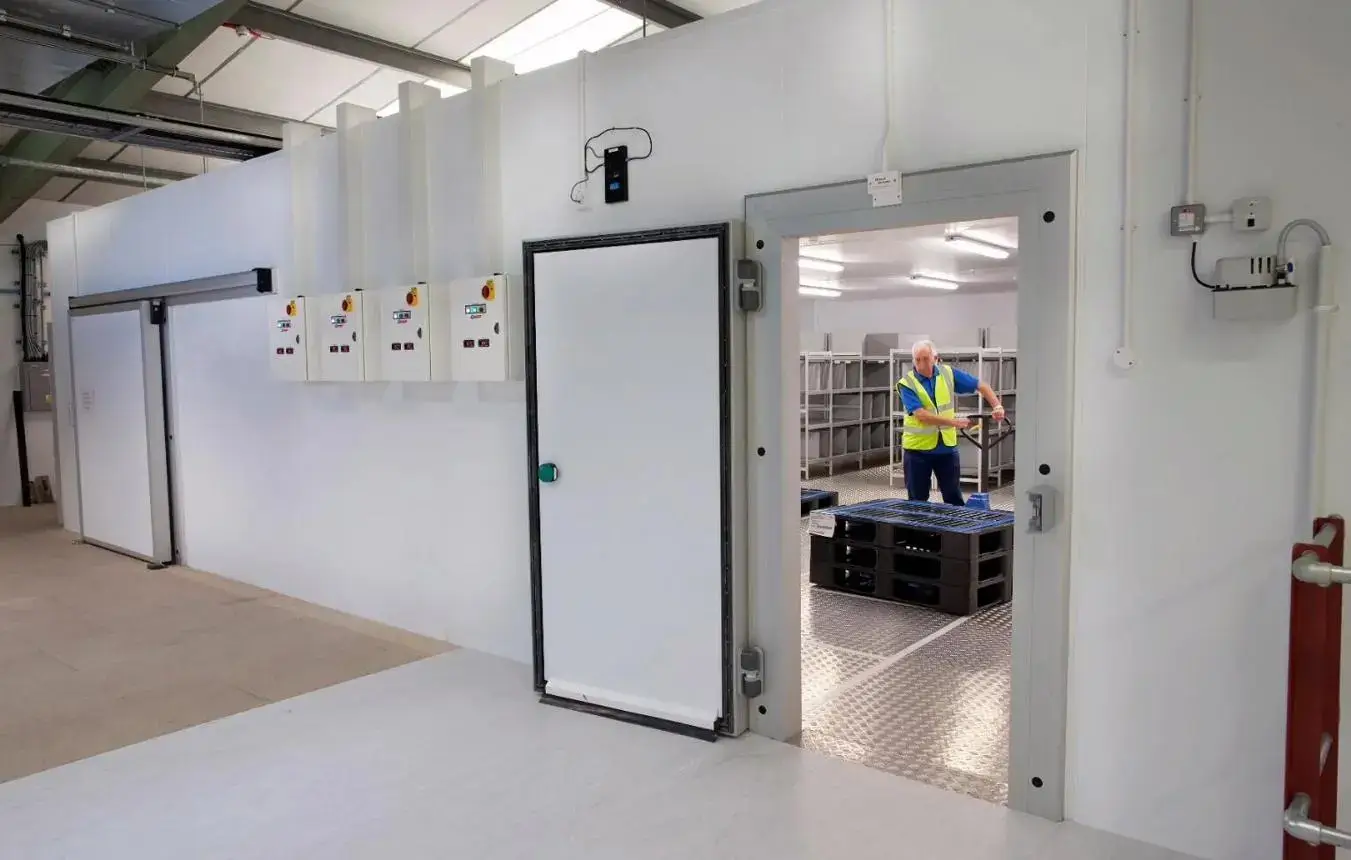
If you need a smaller walk-in room rather than a plant, our Commercial Refrigeration London page covers that side of the work.
Industrial Systems We Install
These are the five systems we build most often, and the refrigerants each one typically runs on.
| System | Refrigerant | Typical Industry |
|---|---|---|
| Process chiller | Ammonia (NH3) or CO2 | Food processing, brewing, dairies |
| Spiral freezer | Ammonia | Bakeries, poultry, ready meals |
| Blast freezer | Ammonia or HFC | Meat, seafood, prepared foods |
| Industrial cold store | Ammonia or CO2 | Distribution, third-party logistics |
| Plate / contact freezer | Ammonia or brine | Fish and seafood processing |
Process Cooling for Manufacturing
Process cooling removes heat from a product or a machine rather than from a room. Breweries use it to control fermentation. Dairies use it to drop milk temperature fast after pasteurising. Plastics and chemical plants use it to hold a reaction within a tight band. In each case the cooling is part of the production process, so a failure stops output rather than just warming a store.
We size process plant against your real duty cycle, including peak loads and future expansion. That usually means a buffer vessel and variable-speed drives on the compressors. We also link the controls to your site monitoring. Faults then raise an alarm before you lose product.
The three duties we see most are fermentation control in brewing, rapid milk cooling after pasteurising, and mould cooling on plastics lines. Each one has a different peak shape, and guessing that shape is where most plants lose money on power.
Ammonia and CO2 Refrigerant Systems
Ammonia (NH3) remains the refrigerant of choice for large industrial plant. It is efficient, it has no global warming potential, and it has been used safely for over a century. It does need respect. You must design ammonia plant to recognised standards, with gas detection, ventilation and trained operators.
CO2 systems suit sites that want a low-GWP option without an ammonia charge. They work well in smaller industrial stores and transcritical systems. Our engineers work on both, and we advise honestly on which fits your duty, your site layout and your operator training.
Refrigerants Compared
| Refrigerant | Strengths | Watch Out For |
|---|---|---|
| Ammonia (NH3) | Best efficiency at scale, GWP of zero, a century of safe use | Needs gas detection, ventilation and trained operators |
| Carbon dioxide (CO2) | GWP of 1, no toxic charge, compact pipework | High operating pressures, transcritical control needed in warm weather |
| HFC and HFO blends | Familiar to most engineers, simple retrofit path | Higher GWP, phase-down pressure on supply and price |
| Secondary glycol or brine | Keeps the primary charge small and out of the work area | Pumping energy, and corrosion if the inhibitor drops |
Refrigerant choice is regulated. UK rules on fluorinated gases set leak-check frequency and record-keeping duties, which you can read on the GOV.UK F-Gas guidance pages.
Design, Installation and Commissioning
You cannot just bolt industrial plant on site and switch it on. It follows a staged programme so that safety checks happen before anyone charges the system.
- Heat load and design. We calculate the duty, draw the pipework and select the plant.
- Plant room and steelwork. Bases, supports and ventilation go in first.
- Pipework and pressure testing. We weld or braze the joints. Then we pressure test and evacuate them before adding any refrigerant.
- Charge and commission. We charge the system, set the controls, and run it under real load before handover.
Commissioning includes a full controls walkthrough with your operators. You also get written records to show an inspector. We follow HSE guidance for work at height and in confined spaces. Large builds sit under warehouse cold room installation, and smaller commercial systems run through Commercial Cold Room Installation.
Industrial Refrigeration Services Maintenance and Compliance
Planned maintenance is what keeps an industrial plant running for twenty years instead of eight. Our industrial refrigeration services include scheduled visits, leak detection, oil analysis, and vibration checks on compressors, so you replace a bearing on your schedule rather than during a Friday night production run.
What a Maintenance Visit Includes
- Leak detection: We run electronic checks across joints, valves and seals. Then we log them for your F-Gas record.
- Condenser and evaporator cleaning: Fouled surfaces push up discharge pressure and power use.
- Compressor health: We check oil levels, suction and discharge pressures, and running currents.
- Controls calibration: We check sensors, setpoints and defrost cycles against real readings.
- Safety systems: We test gas detection, alarms, emergency stops and ventilation.
- Oil and vibration analysis: We sample the oil and check the compressor, which spots a bearing weeks before it fails.
Statutory Leak Check Frequency
How often the law says you must check depends on how much refrigerant the system holds. This is the schedule we work to.
| CO2 Equivalent Charge | Leak Check Every | Extra Duty |
|---|---|---|
| Under 5 tonnes | No fixed duty, but yearly is best practice | Keep records of any gas added |
| 5 to 50 tonnes | At least every 12 months | Written record of every check |
| 50 to 500 tonnes | At least every 6 months | Records held for inspection |
| Over 500 tonnes | At least every 3 months | Fixed leak detection system required |
Our refrigeration engineers carry out every visit. We set the schedule around your charge size and keep the logbook inspection-ready.
24/7 Emergency Breakdown Cover
When a plant stops, every hour costs product. Our industrial refrigeration services include round-the-clock breakdown cover, with teams who carry the spares that fail most often and work on ammonia, CO2 and HFC systems alike.
| Fault | What You See | What We Do |
|---|---|---|
| High discharge pressure | Plant trips on pressure, room warms | Clean or repair condensers, check fans and water treatment |
| Low suction pressure | Poor cooling, heavy frosting | Find the restriction, test expansion valve, check the charge |
| Compressor failure | Loud running, or no start at all | Test windings and oil, replace or overhaul the unit |
| Refrigerant leak | Charge drops, alarms trigger | Locate and repair the leak, pressure test, recharge and log |
| Controls fault | Erratic setpoints, defrost never ends | Test sensors and relays, reprogram the controller |
For round-the-clock help, use our 24/7 Emergency Refrigeration Repair line.
Recent Industrial Jobs
Three jobs from recent months. Client names withheld, numbers real.
Dairy, West Midlands
Milk was leaving the pasteuriser at 12°C instead of the 4°C target, which capped the whole line's throughput. The existing plate heat exchanger was fouled and the glycol set was undersized. We cleaned and re-gasketted the exchanger and added a second glycol chiller on a duty-standby arrangement. The same engineers run our Cold Room Installation Birmingham work.
Result: Outlet temperature now holds 4°C, and the line runs 18% faster because it no longer waits on cooling.
Frozen food distribution, East Anglia
A 6,000-pallet cold store with two ammonia screw packages, both tripping on high discharge pressure every summer. The evaporative condensers were scaled and one fan motor had failed unnoticed. We descaled the condensers, replaced three fan motors and reset the head pressure control.
Result: Summer tripping stopped. Site power use on the plant fell by roughly 11% across the following quarter.
Craft brewery, Surrey
Fermentation temperatures swinging by three degrees between day and night, which was showing up in the finished beer. We fitted a dedicated glycol loop with variable-speed pumping and separate zone valves for each vessel, then logged a full fermentation cycle to prove it.
Result: Fermentation now holds within half a degree, and batch consistency complaints stopped.
Industries We Serve
Industrial cooling shows up in more places than most people expect. These are the sectors we work in most.
Distribution and 3PL sites often need a warehouse cold room installation. Temperature-controlled pharmaceutical storage follows stricter rules. Read them in the GOV.UK good distribution practice guidance.
Where We Work Across the UK
Industrial contracts run nationwide from our Surbiton base, and the same engineers cover the regional work below. Every area has its own page with local response times.
- Commercial Refrigeration London — all 32 boroughs, 2 to 4 hour target
- Cold Room Installation London — design and build across the capital
- Cold Room Installation Birmingham — Midlands industrial and food sites
- Cold Room Installation Sheffield — South Yorkshire manufacturing
- Cold Room Installation Southampton — port and distribution work
- Cold Room Installation Oxford — labs, colleges and hospitality
- Cold Room Installation Colchester — Essex food production
- Cold Room Repair Northampton — logistics corridor servicing
- Commercial Refrigeration Peterborough — East Anglia cold stores
Not on the list? Call 020 3773 1250 for an honest estimate, or browse all UK services.
Frequently Asked Questions
What counts as industrial refrigeration rather than commercial?
Industrial systems cool a process or a large store, typically with ammonia or CO2, a dedicated plant room, and long pipe runs. Commercial units serve shops, kitchens and small cold rooms with self-contained or split systems.
Is ammonia safe to use in a food factory?
Yes, when the plant is designed and maintained to standard. Ammonia has been used in food plants for over a century. It needs gas detection, ventilation, and trained operators, all of which we provide and document.
How often does industrial plant need a leak check?
It depends on the refrigerant charge. Systems holding the equivalent of 5 to 50 tonnes of CO2 need a yearly check, 50 to 500 tonnes every six months, and above 500 tonnes every three months. We set the schedule from your charge size.
Can you work on plant installed by another contractor?
Yes. We take on existing plant regularly, starting with a full survey so you know its condition before we quote any remedial work.
Do you offer planned maintenance contracts?
Yes. Contracts cover scheduled visits, leak detection, priority breakdown response, and a full logbook. Most industrial clients find the contract pays for itself by avoiding one unplanned shutdown.
How quickly can you attend a breakdown?
Emergency teams run 24 hours a day, seven days a week. Contract clients get priority dispatch. We give you an estimated arrival time when you call, not a vague window.
Should we choose ammonia or CO2 for a new plant?
Ammonia usually wins on efficiency at large scale. CO2 suits sites that want a low-GWP option without a toxic charge, and it works well in transcritical systems. We model both against your duty before recommending either.
Can you work while production keeps running?
Usually yes. We plan changeovers around shutdown windows, work nights and weekends, and stage the job so you keep making product. Where a full stop is unavoidable, we tell you that before you sign.
What size of project do you take on?
From a single process chiller up to full ammonia plants and multi-zone cold stores. We tell you honestly if a job is beyond us rather than bidding and struggling.
Do you provide the compliance paperwork?
Yes. Every visit produces a signed record covering leak checks, gas added or recovered, and the engineer's certification number. We keep the logbook inspection-ready.
More questions are answered on the Cold Room FAQ page.
Get an Industrial Refrigeration Quote
Tell us your duty, your product and your site layout. We survey, calculate the load, and send one fixed price.
ColdTec
Unit 7, 177 Hook Road
Surbiton, KT6 5AR
Email: info@cold-tec.co.uk
Open 24 hours, 7 days a week for emergency support